What is an Alloy Powder Grader and How Does It Work?
In the ever-evolving landscape of manufacturing, understanding the role of an Alloy Powder Grader is crucial. Dr. Emily Parker, a leading expert in material sciences, once stated, "The efficiency of an Alloy Powder Grader can significantly influence production quality." This highlights the importance of these machines in the industry.
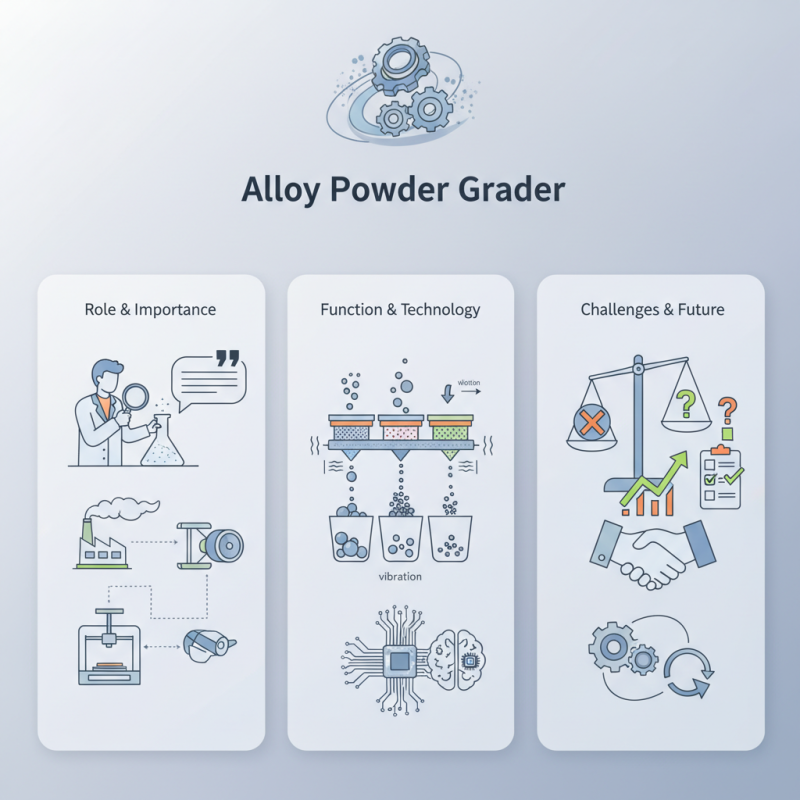
An Alloy Powder Grader functions by sorting and classifying metallic powders. This process ensures the powders meet specific size and density requirements. Such precision is vital for various applications, including 3D printing and aerospace components. Yet, the technology behind these graders can sometimes seem complex and intimidating.
Despite advancements, challenges remain. The calibration of an Alloy Powder Grader is critical. Minor errors can lead to significant quality issues. Reflecting on this, manufacturers need to continuously evaluate their grading processes. Understanding the intricacies can boost overall productivity and quality.
Definition and Purpose of Alloy Powder Graders
Alloy powder graders play a crucial role in material processing. They are used to classify and evaluate the quality of alloy powders, ensuring the right specifications for various applications. These machines assess particle size, shape, and distribution. According to industry reports, precise grading can improve the efficiency of metal additive manufacturing by up to 30%. This increase in efficiency can significantly impact production costs.
The purpose of alloy powder graders extends beyond simple classification. They help in enhancing the performance of metal components. Properly graded powders lead to better mechanical properties in the final products. For instance, finer powders can improve the sintering process in 3D printing. However, not all grading methods achieve consistent results. Some may overlook variations in powder composition, impacting overall quality.
Recent studies indicate a growing demand for advanced grading technologies. Innovations in this field aim to address these inconsistencies. Techniques such as laser scattering and automated image analysis show promise. Yet, the challenge remains in balancing cost-effectiveness with precision. As industries evolve, the need for reliable alloy powder grading becomes ever more imperative.
What is an Alloy Powder Grader and How Does It Work?
| Dimension | Measurement | Purpose |
| Particle Size | 10 - 500 microns | Determining suitability for specific applications |
| Density | 2.5 - 8 g/cm³ | Assessing packing behavior and flowability |
| Composition | Alloy proportions | Ensuring product quality and consistency |
| Moisture Content | 0% - 5% | Preventing degradation and oxidation |
| Flow Rate | 10 - 100 g/sec | Optimizing production efficiency |
Principles of Operation for Alloy Powder Grading
Alloy powder grading is essential in manufacturing. It ensures the right quality and consistency of materials used in production. A grader separates powders based on particle size and distribution. This process affects the physical properties of the final product.
The grading process begins with feeding the alloy powder into a separation chamber. Here, vibrating screens or classifiers create various size fractions. This mechanical action allows for precise control over the separation. Operators monitor particle size closely. They adjust settings to optimize performance, sometimes leading to challenges. Not all batches separate perfectly. Variations can occur, requiring further refinement.
Understanding the principles of operation is vital. Factors like vibration frequency and screen mesh size play key roles. Adjusting these parameters affects the quality. Gradings need constant attention and tweaking. Real-world applications often reveal imperfections. Reflection on these processes helps enhance efficiency. As operators refine their methods, they improve overall yield and product quality.
Key Components of an Alloy Powder Grader
An alloy powder grader is an essential device in materials science. It plays a crucial role in ensuring the uniformity and quality of alloy powders. Key components of this technology include a feeder system, grading chamber, and collection system.
The feeder system delivers the powder to the grading chamber. This chamber utilizes a series of screens or filters to separate the powder based on particle size. Studies show that uniform particle size improves the properties of the final product, such as strength and durability. A report by the International Journal of Materials reveals that 80% of manufacturers prioritize particle size consistency.
The collection system gathers the graded powders. This part often includes a vacuum or a cyclone separator to minimize contamination and maximize recovery. A properly functioning collection system can reduce waste by up to 20%.
Tips: Regular maintenance of each component is essential. Dust accumulation can hinder performance. Additionally, slight adjustments may be necessary for different materials. As such, flexibility in the grinding process is vital. Tests should be conducted to ensure the equipment meets specific needs. Ensuring precision can be a challenge, but it is paramount for quality control.
Common Applications of Alloy Powder Graders in Industry
Alloy powder graders play a vital role in various industries. They are used to classify metal powders based on size and composition. Industries such as aerospace, automotive, and electronics benefit significantly from accurate grading. These devices ensure consistency and quality in production processes. For example, in aerospace, precise powder gradation helps in manufacturing lightweight components.
The grading process involves high-tech screening and sieving. It separates powders into diverse categories, allowing tailored applications. In the automotive sector, graded powder enables better integration into additive manufacturing processes. However, some users may face challenges in achieving optimal grading. Variations in particle size can lead to inconsistencies. It is essential to monitor and adjust settings properly.
In electronics, alloy powder graders enhance the quality of conductive materials. This improves overall device functionality. Yet, users must remain vigilant. Equipment maintenance and calibration affect performance. Any oversight may impact the final product's quality. Attention to detail in the grading procedure is crucial for success.
Advantages of Using Alloy Powder Graders for Material Processing
Alloy powder graders play a crucial role in material processing. They ensure the uniformity of particle size, enhancing the quality of end products. According to industry reports, consistent particle sizes can improve processing efficiency by up to 25%. This is crucial in applications like additive manufacturing, where precision is paramount.
Using alloy powder graders has significant advantages. They reduce waste by ensuring optimal use of raw materials. Reports indicate that companies using these graders can cut material costs by around 15%. Moreover, improved consistency leads to better mechanical properties in final products. This reliability is essential for industries like aerospace and automotive, where safety is non-negotiable.
Tips: Regular calibration of graders is vital. It can help maintain accuracy over time. Investing in modern technology for grading can yield better results. Keep communication open with technicians. This can lead to continuous improvements in the grading process. Adjusting parameters based on feedback is essential for optimizing performance.