
1-208-754-4884

China Top Crystal Table Manufacturers for Global Buyers

China has become an important sourcing hub for Crystal Table products, serving hotels, restaurants, retailers, and residential projects worldwide. Its manufacturers offer varied designs, from clear glass dining tables to illuminated reception tables with crystal-inspired details. However, attractive photos do not prove manufacturing quality. Buyers need practical evidence.

This guide examines China’s top Crystal Table manufacturers through product quality, production experience, customization ability, and export reliability. It considers tabletop thickness, edge polishing, frame stability, load capacity, packaging, and replacement support. A dependable factory should explain its materials clearly and provide samples, drawings, inspection records, and realistic production schedules. Factory audits, video inspections, and third-party testing can reduce uncertainty before payment. Small details matter. A carefully protected corner can prevent costly damage during ocean transport.

Experienced buyers also compare communication speed, finish consistency, and after-sales procedures. These factors often reveal more than a polished catalogue. Some manufacturers may excel at custom shapes but lack strong international logistics. Others may deliver stable production but offer limited design flexibility. No supplier is perfect. That deserves honest consideration.

The right choice depends on project use, budget, order volume, and destination requirements. Buyers should confirm applicable safety expectations, documentation, and import responsibilities before signing contracts. This overview aims to support a careful, evidence-based decision. It does not treat factory size as the only measure of trust. A smaller workshop may provide close attention, while a larger producer may offer stronger capacity. The best result comes from verifying both.
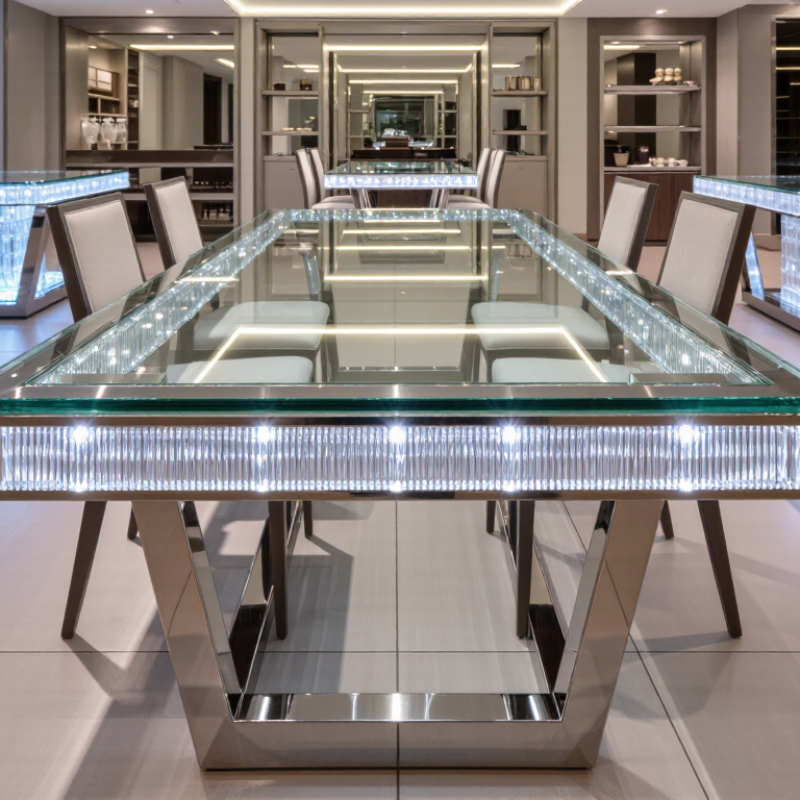
China Top Crystal Table Manufacturers for Global Buyers

What Is a Crystal Table and Why Does It Matter?

What Is a Crystal Table and Why Does It Matter?

A crystal table is usually not carved from one natural crystal. In furniture trade, the term often describes a table using crystal-clear glass, engineered quartz, or decorative mineral surfaces. Its value depends on clarity, edge finishing, structural design, and safe handling. A transparent top can make a small room feel larger, while polished edges catch daylight like water.

Material choice matters. The U.S. Geological Survey reported about 105 million metric tons of industrial sand and gravel produced in the United States in 2023. This material supports many glass products, including furniture glass. Meanwhile, industry analyses from Grand View Research identify continued growth in the global glass furniture market, driven by modern interiors and space-conscious design. These figures show demand, not automatic quality.

A reliable manufacturer should provide glass thickness, tempering details, load tests, and inspection records. Ask whether the surface resists thermal shock and whether the base remains stable on uneven floors. A crystal table may look weightless. It is not.

Poorly matched hardware can create stress around drilled holes or metal joints. I have found that visual brilliance sometimes hides practical weaknesses. That deserves more attention.

Procurement teams should also verify packaging tests, moisture protection, and replacement-part availability before approving large orders. A beautiful sample is only evidence of one successful sample.

China’s Leading Crystal Table Manufacturing Regions and Capabilities

China Top Crystal Table Manufacturers for Global Buyers

China’s crystal table production is concentrated in several practical manufacturing regions. Guangdong supports large export orders, with strong glass cutting, edge polishing, metal fabrication, and assembly capacity. Foshan and Zhongshan are especially useful for coordinated furniture supply chains. Factories can combine crystal or tempered glass surfaces with stainless steel, aluminum, wood, or engineered stone bases. Many workshops also provide custom dimensions, drilled holes, curved edges, and protective packaging.

Zhejiang is known for flexible furniture production and responsive order handling. Its factories often serve hospitality, residential, and commercial projects. Jiangsu offers stronger industrial support, including CNC processing, precision polishing, and structured quality control. Buyers should request physical samples before approving mass production. Digital images hide surface waves, edge marks, and color differences.

Manufacturing capability varies widely between suppliers. Experienced factories usually maintain inspection records for thickness, flatness, load performance, and packaging strength. They may test corner protection with drop simulations and inspect each polished edge under direct light. Ask for material certificates and clear tolerance ranges. Small details matter. A perfect tabletop can still arrive damaged if the crate design is weak. No region is flawless. Some suppliers communicate well but lack finishing consistency, while others produce excellent samples and struggle with delivery discipline. Global buyers should compare factory experience, sample quality, production tracking, and after-sales responsiveness together. That approach is slower, but safer.

How to Evaluate Chinese Crystal Table Manufacturers

When evaluating Chinese crystal table manufacturers, look beyond polished catalog photos. Request a physical sample with measured dimensions, glass thickness, edge finishing, and frame details. A reliable supplier should explain whether the surface is crystal glass, tempered glass, or another material. Ask for load-test records and production photos from the current facility.

Factory experience matters, but communication reveals operational discipline. Confirm the minimum order quantity, sample charge, production lead time, and replacement policy in writing. Check how each table is packed. Foam corners, separated panels, and moisture-resistant cartons reduce damage during ocean transport. Independent inspections can verify color consistency, weld quality, stability, and carton markings before shipment.

Do not rely on certificates alone. Verify their issuing details and ensure they match the actual product. Request references from similar export markets, while protecting confidential buyer information. A video factory tour helps, but it cannot replace an on-site audit. No checklist is perfect. A beautiful sample may hide weak bulk production, and an attractive price may exclude essential packaging. Leave room for small errors, yet document every tolerance clearly. Manufacturers that answer difficult questions directly are usually safer partners for long-term purchasing.

China Top Crystal Table Manufacturers for Global Buyers - How to Evaluate Chinese Crystal Table Manufacturers

Evaluation Dimension What Global Buyers Should Check Recommended Benchmark Evidence to Request Suggested Weight
Product Definition Confirm whether “crystal” refers to crystal glass, tempered glass, laminated glass, engineered quartz, or another material. Material specification clearly stated Technical datasheet, material declaration, sample label, and approved drawing 10%
Glass Safety For glass tabletops, verify heat-treatment quality, edge finishing, impact resistance, and safe breakage characteristics. Tempered glass tested to the applicable market standard Tempering records, inspection reports, and applicable EN 12150 or equivalent test documentation 15%
Dimensions and Tolerances Review tabletop length, width, thickness, hole positions, flatness, and frame alignment against the approved drawing. Written tolerances for every critical dimension Signed drawings, dimensional inspection report, and first-article sample 12%
Surface and Edge Quality Inspect polishing, bevels, corners, surface scratches, bubbles, inclusions, color consistency, and visible optical distortion. No sharp edges, cracks, chips, or unacceptable visible defects Defect classification standard, inspection photos, and production samples 12%
Structural Design Evaluate the stability of the base, joints, fasteners, load-bearing points, anti-tip features, and compatibility of glass with the frame. Stable under the buyer’s specified static and handling loads Assembly drawings, load test results, joint specifications, and sample inspection 15%
Material Compliance Check whether coatings, adhesives, metals, packaging materials, and other components meet the destination-market requirements. Applicable chemical and product requirements documented REACH or RoHS declarations where applicable, safety data, and third-party test reports 10%
Quality Management Assess documented control of incoming materials, production checks, final inspection, corrective actions, and traceability. Documented quality system with batch traceability Quality manual, inspection checklist, corrective-action records, and valid ISO 9001 certificate if claimed 10%
Production Capacity Verify whether the facility can handle the required size, finish, quantity, packaging method, and repeat-order schedule. Capacity supported by actual equipment and production records Factory audit, equipment list, production plan, and recent non-confidential capacity records 8%
Customization Capability Review capability for custom shapes, thicknesses, colors, printing, metal finishes, bases, packaging, and private specifications. Prototype approval before mass production Prototype, signed sample approval, engineering change procedure, and tooling quotation 8%
Packaging and Export Readiness Check protection against glass breakage, abrasion, moisture, vibration, and incorrect handling during international transportation. Export packaging validated by drop or handling tests Packaging specification, carton or crate photos, packing list, and trial-shipment feedback 5%
Lead Time and Delivery Control Compare sample lead time, production lead time, inspection time, shipping readiness, and the supplier’s ability to communicate delays. Written schedule with milestone dates Proforma invoice, production schedule, shipment records, and agreed delay procedure 3%
Commercial Terms and After-Sales Support Evaluate payment terms, warranty scope, replacement policy, spare parts, claims handling, and responsibility for confirmed defects. Clear written warranty and claims process Sales contract, warranty terms, replacement procedure, and documented communication channel 2%
Total Evaluation Weight 100%
Recommended Evaluation Method: Score each dimension from 1 to 5, multiply the score by the assigned weight, and compare suppliers using the same approved specifications, samples, inspection criteria, and delivery terms.

Customization, Quality Control, and International Compliance

China Top Crystal Table Manufacturers for Global Buyers

Customization begins with a usable specification, not a vague picture. Experienced manufacturers can adjust tabletop size, crystal tint, edge shape, base materials, and packaging design. CAD drawings should show measurements, joining points, tolerances, and surface requirements. A physical sample remains important. Digital images can hide small distortions.

Quality control needs visible checkpoints. Inspectors should verify crystal clarity, edge polishing, thickness, color consistency, and base stability. Load testing can reveal weak joints before shipment. Factory teams may also check carton compression, moisture protection, and labeling. No supplier should promise zero defects. A first sample may look excellent, while later batches need closer supervision. That risk deserves attention.

International compliance depends on the destination market and product design. Buyers should request material declarations, test reports, packing details, and traceable batch records. Relevant requirements may include chemical restrictions, product safety rules, packaging regulations, and formal customs documents. These obligations can differ between countries. Confirm them before production. Third-party inspections add independence, but they do not replace clear factory procedures. Ask who performed each test, when it was completed, and which sample was examined. Reliable manufacturers answer with documents, not confidence alone. Supplier audits, production photos, and signed inspection standards create stronger evidence for global purchasing decisions.

Key International Frameworks for Crystal Table Export Readiness

This chart highlights recognized reference years for quality management, environmental management, workplace safety, wood packaging, and chemical compliance frameworks commonly reviewed by global buyers. Applicability depends on the destination market, materials, packaging, and product configuration.

Reference years: ISO 9001:2015, ISO 14001:2015, ISO 45001:2018, ISPM 15:2018, and EU REACH:2007.

Ordering, Shipping, and After-Sales Support for Global Buyers

China Top Crystal Table Manufacturers for Global Buyers

Ordering crystal tables requires more than comparing online prices. Ask manufacturers for exact dimensions, crystal thickness, edge treatment, load limits, and base materials. Request a physical sample when the project is high value. A clear quotation should separate product cost, packaging, tooling, inspection, and inland transport. Confirm production drawings before paying the balance. This small step prevents expensive misunderstandings.

Check the factory’s export experience and quality process. Photos are useful, but inspection records provide stronger evidence. Ask how workers protect polished edges and prevent scratches during assembly. Before shipment, use an independent inspection service or request dated production images. I have found that packaging deserves equal attention. Foam corners, moisture barriers, and reinforced cartons can reduce damage. Still, no packaging plan is perfect.

Shipping terms must be written clearly. Confirm the port, delivery responsibility, insurance coverage, customs documents, and estimated transit time. A wooden crate may need compliant treatment documentation. Delays can happen during peak seasons, so avoid promising installation dates too early. That is a common planning mistake. After-sales support should include replacement procedures, response times, spare parts, and guidance for minor repairs. Ask who pays when damage appears after opening the crate. Keep photographs, videos, invoices, and inspection reports in one file. Good communication is practical evidence, not just polite service. Some suppliers respond quickly before payment, then become slower afterward. Test their support with detailed questions before placing a large order.