
1-208-754-4884

How to Choose Tube End Forming Machines in 2026?

Choosing Tube End Forming Machines in 2026 is not just a question of speed or purchase price. The right machine must form your actual tube material, diameter, wall thickness, and end profile without cracking or unwanted distortion. Bring production samples to a supplier trial. Inspect the finished ends, measure repeatability, and record cycle time and changeover time. Fit matters.

Automation is also changing equipment decisions. Deloitte’s 2024 Smart Manufacturing Survey reported that 86% of surveyed manufacturing executives saw smart manufacturing as a primary driver of competitiveness over the next five years. That finding concerns manufacturing broadly, not tube end forming alone. Still, it makes controls, data access, and integration worth checking. Ask whether the machine can store recipes, track process settings, and connect with your existing production system. Then test.

Shigeo Shingo, a manufacturing engineer and industrial-engineering expert, wrote, “The most dangerous kind of waste is the waste we do not recognize.” For buyers, that is a useful warning: a low quoted price can hide slow tooling changes, difficult setup, scrap, or long service delays. Compare total operating needs, not just the machine’s headline specifications. This guide will help you assess forming capability, tooling, automation, safety features, supplier support, and cost of ownership. Some trade-offs will remain. A highly automated system may not suit a short run or frequent design changes. The best choice depends on your parts, operators, and production plan.
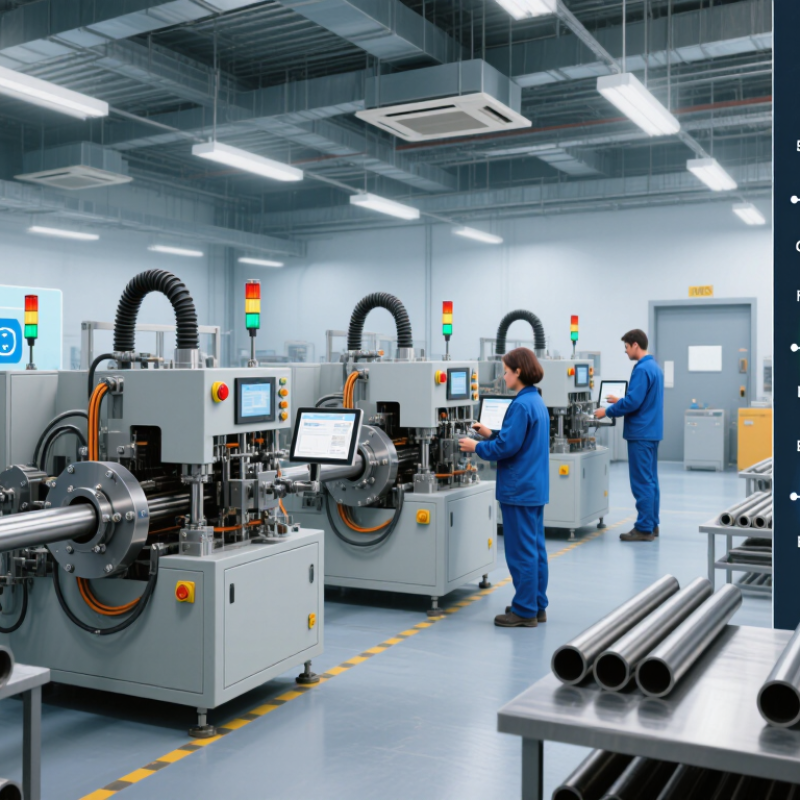
How to Choose Tube End Forming Machines in 2026?

Understanding Tube End Forming Processes and Their Applications

Tube end forming reshapes a tube’s open end without replacing the full component. Common operations include flaring, reducing, beading, grooving, and swaging. Each creates a different joint or connection. Small details matter. A flare can improve hose seating, while a bead can help retain a clamp. The right process depends on tube material, diameter, wall thickness, and required tolerances. It also depends on production volume. A setup that works for short runs may be too slow for repeated, high-volume parts.

Applications span vehicle exhausts, fluid lines, furniture frames, heat exchangers, and building systems. OICA reported 93.5 million motor vehicles produced worldwide in 2023, showing the scale of one potential application base—not machine demand. The World Steel Association’s World Steel in Figures 2024 reported 1,888.2 million tonnes of crude steel production in 2023, underscoring the importance of forming processes across steel supply chains. When evaluating equipment, check tool-change time, forming force, repeatability, and compatibility with the actual tube alloy. A sample run is useful. Yet it may not reveal tool wear or variation across a full shift. That limitation is easy to overlook.

How to Choose Tube End Forming Machines in 2026?

Qualitative guide to matching common tube-end forming processes with typical production needs. Ratings are comparative guidance, not measured performance data.

How to read it: Higher scores indicate a stronger typical fit. Rotary swaging is commonly used for localized reduction and repeatable production; ram forming suits axial forming operations; rotary flaring is used to enlarge or flare tube ends. Confirm machine capacity, tube material, wall thickness, geometry, and required tolerances with application-specific trials.

Matching Machine Capabilities to Tube Materials and Dimensions

How to Choose Tube End Forming Machines in 2026?
Matching Machine Capabilities to Tube Materials and Dimensions

Start with the tube, not the machine’s maximum capacity. Record outside diameter, wall thickness, material grade, and required end shape. Thin-wall aluminum can wrinkle under pressure, while stainless steel may need greater forming force and carefully matched tooling. Copper is softer, but it can still split if the feed or forming sequence is poorly controlled. Small details matter.

Check the machine’s working range against your actual production parts. A unit rated for a broad diameter range may not hold the same accuracy across every size. Ask for sample runs using your tube material and wall thickness. Inspect the finished end for cracks, uneven flare, ovality, and dimensional variation. Also consider tool-change time if your jobs involve frequent changes in diameter or form. A fast cycle is useful, but only when the result stays consistent.

Tips: Bring real tube samples and a dimensioned drawing to the machine evaluation. Confirm tooling availability, setup adjustments, and repeatability across several parts. Keep a little capacity margin for future work, but avoid buying far beyond your current tube range; excess capacity does not guarantee better forming. I would still verify the setup on the shop floor. That step is easy to overlook.

Comparing Forming Methods, Tooling, and Machine Configurations

How to Choose Tube End Forming Machines in 2026?
Comparing Forming Methods, Tooling, and Machine Configurations

Choosing a tube end forming machine starts with the finished end, not the machine’s headline capacity. Flaring, reducing, beading, and flanging each place different demands on the tube wall. A thin stainless tube may wrinkle during reduction, while a short flare can split if its edge is rough. Review material, diameter, wall thickness, and required tolerances together. Then compare forming methods against actual sample parts. A machine that handles one operation well may need extra tooling for another.

Tips: Ask for a trial using your tube material and dimensions. Inspect the finished end for cracks, uneven walls, and fit. Check setup time too. It can quietly reduce output.

Tooling affects repeatability as much as machine power. Matched dies, sound alignment, and controlled clamping help prevent marks and inconsistent shapes. For frequent product changes, consider quick-change tooling and accessible adjustment points. A manual configuration may suit low-volume work; hydraulic or servo-controlled systems can support higher throughput and more repeatable cycles. But added automation is not automatically better. It can raise setup and maintenance demands. Compare cycle time, changeover time, operator access, and service requirements. One detail is easy to miss: a fast machine is less useful if its tooling takes too long to change. Test the configuration with representative parts before committing.

How to Choose Tube End Forming Machines in 2026? - Comparing Forming Methods, Tooling, and Machine Configurations

Forming method How the process works Typical end forms Tooling considerations Common machine configuration Best suited for Key limitations and checks
Rotary swaging Radially moving dies repeatedly strike the tube, reducing its diameter around a mandrel or over an internal support. Reduced ends, tapers, stepped ends, and pointed or shaped ends. Die profile and material determine the finished shape; mandrels help control the inside diameter and support the workpiece. Rotary swaging head with interchangeable dies; may be manual, semi-automatic, or integrated into a production line. Repeatable diameter reduction, tube preparation for insertion, and high-volume production of formed ends. Check for wall-thickness changes, surface marking, and the need for internal support. Suitability depends on material ductility and tube dimensions.
Axial end forming A punch or forming tool applies force along the tube axis, upsetting or displacing material into a die cavity. Beads, flanges, collars, expanded ends, and other features formed by axial displacement. Matched dies, punches, and—in some applications—an internal mandrel support the tube and define the final profile. Hydraulic or servo-electric press with a dedicated end-forming station; multi-station versions can perform successive operations. Defined end features where controlled axial material flow and a consistent seating surface are important. Excessive forming can cause wrinkles or buckling. Confirm available material length, wall thickness, and the required support method.
Rotary forming or spinning One or more rollers progressively move material against a rotating tube or tool, forming the end over multiple passes. Flares, beads, rolled edges, and contoured profiles. Roller geometry and forming sequence affect the profile; changeover may require application-specific rollers and setup. Rotary end-forming machine with a rotating spindle, forming rollers, and a tube clamping system. Gradual forming of axisymmetric ends and applications where a smooth, rolled profile is required. Cycle time and achievable geometry depend on the number of passes, material behavior, and workpiece support. Validate runout and concentricity.
Roll forming Rolls progressively shape the tube end as the workpiece is fed or rotated through the tooling. Beads, grooves, hems, and other rolled end details. Roll profiles and roll spacing must match the required geometry; tooling wear can affect profile consistency. Dedicated roll-forming station or in-line machine with adjustable or interchangeable rolls. Repeated production of consistent rolled features, particularly when the geometry can be produced in a continuous or progressive operation. Not every end shape is accessible to rollers. Check tool access, tube clamping, edge condition, and the effect of forming on the tube wall.
Hydroforming Pressurized fluid expands the tube into a closed die; axial feeding may be used to manage material flow and fill the cavity. Expanded ends, bulges, transitions, and selected complex shapes defined by the die. Requires a sealed die and pressure system; sealing surfaces and die design are central to repeatability. Hydroforming press with a pressure intensifier, sealed tooling, and controls for pressure and, where applicable, axial feed. Complex shapes that are difficult to produce with a simple punch or roller operation. Higher system and tooling complexity; assess sealing, pressure requirements, cycle time, and material formability before selection.
Press forming with segmented or split dies A press drives the tube into or against a die set; split or segmented tooling can open for loading and release formed profiles. Expanded or reduced ends, shoulders, and profiles that can be produced with a closed or segmented die. Die segments, punch geometry, and any internal support must be matched to the tube and the release path of the finished part. Mechanical, hydraulic, or servo-electric press with a purpose-built tool set; often suitable for automated loading. High-volume work with a stable part design and a clearly defined forming sequence. Tool access and part removal can constrain geometry. Check for wrinkling, cracking, and dimensional variation during trials.
Tooling and support strategy Tooling may use external dies alone, an internal mandrel, a punch, rollers, or a sealed die, depending on the forming method. Controls the profile, inside diameter, wall support, and repeatability of the formed feature. Compare changeover time, tool life, inspection needs, and whether one tool set can cover the required part family. Quick-change tooling is useful for frequent product changes; dedicated tooling can suit stable, repetitive production. Operations with known tube dimensions, material grades, and end-profile tolerances. Confirm tooling compatibility with the actual tube material, outside diameter, wall thickness, and required tolerances.
Machine configuration and controls Machines range from single-operation units to multi-station or automated cells with feeding, clamping, and part handling. Configuration affects throughput, setup effort, process monitoring, and integration with upstream or downstream operations. Consider the number of tools and stations, changeover access, guarding, and availability of process monitoring. Manual or semi-automatic machines for flexible, lower-volume work; automated or multi-station systems for repeatable production runs. Selection should reflect production volume, product mix, operator involvement, and available floor space. Compare total cycle time and changeover time—not just forming speed. Confirm that the controls and safety features suit the intended operation.

Selection note: Forming capability and achievable tolerances vary with tube material, outside diameter, wall thickness, length, and end geometry. Treat machine and tooling suitability as application-specific and validate it with representative production samples.

Evaluating Precision, Production Speed, Automation, and Safety

Choosing a tube end forming machine in 2026 means comparing more than catalog cycle times. Check precision using your own material, wall thickness, and end profile. Run a sample batch, then measure flare diameter, concentricity, and repeatability with calibrated gauges. A fast machine is not useful if operators spend each shift correcting oval ends. Ask for results across a sustained run, not one polished demonstration.

Production speed depends on loading, changeovers, and reject handling as much as ram speed. Deloitte and MAPI’s 2024 Smart Manufacturing Survey found that 86% of manufacturing executives expect smart factory solutions to drive competitiveness within five years. That is a broad manufacturing finding, not proof that every automated cell pays back. Compare automatic feeding and recipe storage against your batch sizes, product mix, and staffing. Paper specs can mislead.

Safety needs equal scrutiny. Observe the operator loading a tube, clearing a jam, and changing dies. Check guarding, interlocks, and accessible emergency stops. The U.S. Bureau of Labor Statistics reported 2.8 recordable injury and illness cases per 100 full-time workers in manufacturing in 2023. This is sector-wide context, not a machine-specific risk estimate. Request documented risk assessments and maintenance procedures, then verify them on the shop floor. And listen closely.

Assessing Total Cost, Supplier Support, and Long-Term Reliability

A tube end forming machine may look affordable until tooling, installation, training, and downtime enter the budget. Compare the full cost over several years, not just the purchase price. Ask suppliers to list standard tooling, changeover parts, shipping, and recommended maintenance in writing. Then estimate the cost of a typical production week, including setup time and rejected parts. Small details count.

Supplier support is part of the machine’s value. Ask how quickly technicians respond, whether remote troubleshooting is available, and which spare parts are kept in stock. Request a sample maintenance schedule and confirm that operators can learn safe setup procedures. A polished demonstration is useful, but it cannot show every production problem. I would want to see the machine form the actual tube material and wall thickness used on the shop floor.

Long-term reliability depends on more than a strong frame. Check access to wear components, the clarity of fault messages, and how easily settings can be repeated between shifts. Ask for references from operations with similar workloads, then discuss service interruptions as well as successes. No machine runs perfectly forever. I would also admit that projected savings can be wrong when product mix changes; revisit the estimate using real cycle times and maintenance records after installation.