How to Select the Right Thermistor Input for Your Application?
Choosing the right Thermistor Input for your application can be challenging. With numerous options available, understanding key factors is crucial. Thermistor inputs are sensitive and versatile, making them suitable for various temperature measurement tasks. However, not all thermistors are created equal.
When selecting a thermistor input, consider your specific needs. Different thermistors react differently to temperature changes. Some may operate well in high-temperature environments while others excel in lower ranges. The accuracy of the readings can greatly impact your project's success, especially in critical applications like medical devices or industrial processes.
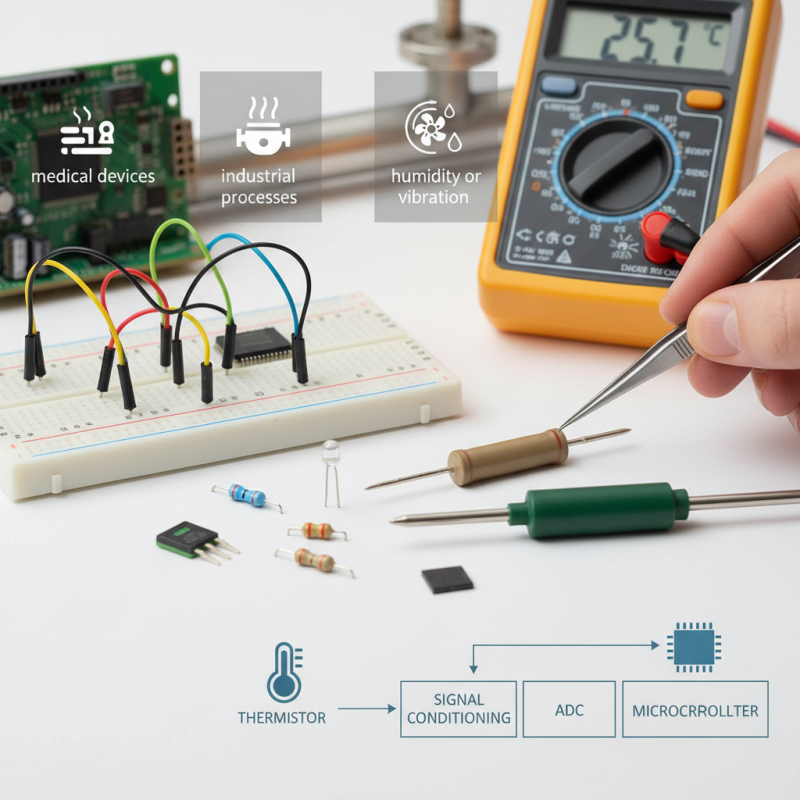
Moreover, you must factor in environmental conditions. A thermistor input's reliability is often tested in real-world scenarios. It's essential to evaluate how external factors, such as humidity or vibration, may influence performance. Reflecting on the potential limitations can provide valuable insights and lead to more informed decisions. Ultimately, selecting the right thermistor input is not just about specifications; it's about understanding the broader context of its application.
Factors to Consider When Choosing a Thermistor Input
When selecting the right thermistor input for your application, several key factors come into play. The resistance value at a specific temperature is crucial. This value determines the thermistor's sensitivity and range. A low resistance thermistor will respond quickly to temperature changes, while a higher resistance model might be more stable. Knowing the typical operating temperature range allows engineers to make informed choices.
Another important factor is the thermistor type. There are NTC (Negative Temperature Coefficient) and PTC (Positive Temperature Coefficient) thermistors. NTCs decrease in resistance with an increase in temperature, making them ideal for temperature sensing. PTCs, conversely, can be used for overcurrent protection. Understanding the application context will guide you in choosing the suitable type.
Additionally, consider your environment. Factors like humidity and potential exposure to chemical agents can affect thermistor performance. It's vital to assess these operating conditions. While a thermistor may work perfectly in one setting, it might fail in another. Avoiding overconfidence in a single choice is important. Testing prototypes under real conditions could reveal unexpected challenges. Balancing these considerations ensures that the selected thermistor meets your application's specific requirements.
Understanding Different Types of Thermistors: NTC vs PTC
Thermistors are crucial for temperature sensing in various applications. Two main types exist: NTC (Negative Temperature Coefficient) and PTC (Positive Temperature Coefficient). Each type has unique characteristics that suit different needs. Understanding these differences helps in selecting the right thermistor for specific applications.
NTC thermistors decrease resistance as temperature rises. They offer high sensitivity and are ideal for precise temperature measurement. Commonly found in medical devices and HVAC systems, their performance is influenced by nearby components. Engineers need to carefully consider this interaction to avoid inaccuracies.
On the other hand, PTC thermistors increase resistance with rising temperature. These are often used for overcurrent protection and self-regulating heating applications. Their simpler design allows for robust performance in harsh environments. However, selecting the right specifications is crucial. That way, the thermistor's response remains reliable under varying conditions. Understanding these nuances is vital for optimal application performance.
Evaluating Temperature Range and Sensitivity for Your Application
Selecting the right thermistor input for your application requires careful consideration of temperature range and sensitivity. Thermistors are temperature-sensitive resistors used in various fields, from medical devices to automotive systems. According to industry reports, a significant number of thermal management failures stem from improper thermistor selection. Ensuring precise temperature readings is crucial, especially when the range of operation varies.
Evaluating temperature range is necessary. Typical thermistors operate within -55°C to 125°C. Understanding the extremes of your application's environment can prevent damage or inaccuracies. For example, medical devices function best at specific temperature thresholds. Choosing a thermistor that matches these needs can lead to improved performance and reliability.
Tips: Always validate thermistor specifications against your application requirements.
Sensitivity is another key factor. The sensitivity of a thermistor defines how much the resistance changes with temperature. A highly sensitive thermistor may respond faster, but it may also provide less stability at extreme ranges. Strike a balance to prevent erratic behavior.
Tips: Test thermistors in real-world conditions before finalizing your choice.
Ignoring these factors can lead to costly operational failures. Take the time to explore different options. Your choice of thermistor can deeply impact performance and safety in your application.
Assessing Response Time and Thermal Mass in Thermistor Selection
Selecting a thermistor input involves a careful assessment of response time and thermal mass, critical factors in various applications. Response time indicates how quickly a thermistor reacts to temperature changes. A faster response is vital in dynamic environments where temperature fluctuations are rapid. For instance, studies have shown that thermistors can have response times as low as 1 second in specific setups, making them suitable for applications like HVAC systems.
Thermal mass relates to how much heat a thermistor can absorb before significant temperature changes occur. High thermal mass may dampen quick responses, which is undesirable in fast-changing conditions. However, a certain level of thermal mass can enhance stability in fluctuating environments. Reports suggest that optimizing thermal mass can lead to more precise measurements in applications requiring high accuracy, such as medical devices. Balancing these factors often requires extensive testing and adjustments, as finding the right thermistor can be a nuanced challenge.
It’s important to reflect on the trade-offs. In some cases, a thermistor with excellent response time may suffer from lower precision due to inadequate thermal mass. As reported by industry experts, the ideal thermistor is not always the most responsive or the one with the greatest stability. Each application presents unique requirements, making it essential to thoroughly analyze the specific needs to achieve optimal performance.
Thermistor Response Time and Thermal Mass Comparison
Integration with Other Components: Circuit Design Considerations
When selecting the right thermistor input for your application, careful circuit design is crucial. Thermistors come in various types, like NTC and PTC, and each serves different purposes. Integrating them effectively into circuits involves understanding their characteristics and how they interact with other components.
For instance, consider the thermal response time needed in your application. This factor affects how the thermistor reacts to temperature changes. A slow response time may not suit dynamic environments. Also, the layout of your circuit can impact performance. Proximity to heat sources or interference from other components can lead to inaccurate readings.
Power supply variation must be evaluated. Ensure that the voltage levels within the circuit match the thermistor's specifications. Inconsistent power can lead to unreliable data. Moreover, incorporating filtering and signal conditioning can enhance the accuracy of temperature readings, yet this adds complexity. As you work through these considerations, keep the balance between accuracy, complexity, and cost in mind.