
1-208-754-4884

Top 10 CNC Machining Center Manufacturers in the World

Cnc Machining Centers are judged on more than spindle speed. Buyers also weigh accuracy, uptime, service access, and how well a machine fits a real production line. A five-axis center cutting an aerospace housing has different demands from a compact vertical mill making repeat parts. The details matter.

Grand View Research estimated the global CNC machine market at USD 101.22 billion in 2023 and projected a 10.3% compound annual growth rate from 2024 to 2030. That figure covers CNC machine tools broadly, not machining centers alone. It is useful context, but not a direct measure of demand for this specific machine category. Market forecasts also depend on assumptions; they should not replace factory-level evaluation.

Manufacturing scholar Dr. Yoram Koren’s published work on reconfigurable manufacturing systems emphasizes flexibility and responsiveness as central design goals. In practical terms, a machine should support changing workloads without sacrificing process stability. That is a useful lens for comparing global manufacturers, though it is not a substitute for verified machine specifications or customer trials. Some buyers may prioritize automation; others need straightforward maintenance and dependable local support. There is no perfect shortlist.

This guide examines ten leading CNC machining center manufacturers worldwide, focusing on technology, product range, and manufacturing fit. Company scale alone does not settle the choice. A careful comparison starts with the part, the tolerance, and the operator’s daily workflow.
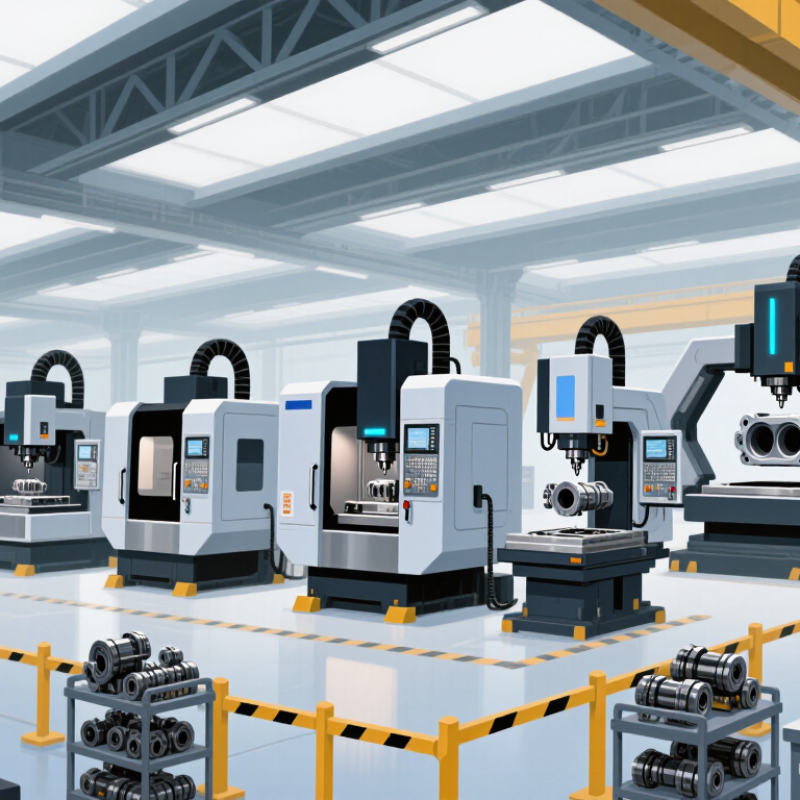
Top 10 CNC Machining Center Manufacturers in the World

CNC Machining Centers Defined: 3-, 4-, and 5-Axis Configurations

A CNC machining center is described by the directions in which its cutting tool or workpiece can move.

In a three-axis setup, the tool travels along X, Y, and Z while the part stays fixed. This arrangement suits many flat faces, pockets, and drilled features. It is often easier to program and inspect. Yet deep cavities can require awkward tool lengths.

Four-axis machines add rotation, usually around one linear axis. A rotary table can expose several sides of a part without manual repositioning. That can reduce setup time and alignment errors. It does not eliminate them. Clamping, tool clearance, and part geometry still shape the result.

Five-axis centers combine three linear movements with two rotational movements. The tool can approach a surface from changing angles, which helps with curved forms and complex components. Fewer setups may improve consistency, especially when locating features across multiple faces. More axes also bring more demanding programming, calibration, and operator training.

Not always a better choice. A practical selection starts with the part’s geometry, tolerance, batch size, and inspection plan—not the axis count alone. Even a capable machine cannot compensate for a poorly planned fixture.

How to Rank Ten Global Manufacturers by Sales, Capacity, and Service Reach

A credible Top 10 CNC machining center ranking should weigh sales, production capacity, and service reach together. Sales indicate market scale, but reported figures may include unrelated business divisions. Compare disclosed machine-tool revenue where possible, and state when estimates are used. No ranking is perfectly clean.

Capacity is more than factory size. Check annual output, product range, delivery lead times, and the ability to support customized configurations. Service reach matters after installation: examine regional technician coverage, spare-parts availability, training options, and response procedures.

Use consistent criteria for every manufacturer, and explain how evidence was gathered. Buyers can verify claims against annual reports, facility information, and service-network details. A large network does not always mean fast support.

Tips:

Separate confirmed facts from estimates. Ask for service locations near your plant and typical parts lead times. Compare like with like, including machine size and configuration. Small data gaps are worth noting; pretending they do not exist weakens the ranking.

Ten Manufacturer Profiles: Origins, Product Lines, and Core Markets

The ten profiles show how regional engineering traditions shape machining centers. A Japanese manufacturer may focus on compact, automated cells for electronics and automotive suppliers. German makers often emphasize rigid machine frames and multi-axis platforms for aerospace and precision engineering. Swiss producers are associated with small, accurate machines serving medical-device and watchmaking workshops. Italian firms commonly offer flexible milling centers for job shops and mold makers.

Taiwanese manufacturers supply a broad range of vertical and horizontal centers, often targeting contract machining and export markets. South Korean builders tend to serve automotive, heavy-equipment, and general manufacturing plants with production-oriented models. US manufacturers cover custom and high-mix work, where operators may value accessible controls and local service. Chinese producers span entry-level machines to advanced, automated systems for domestic and overseas buyers.

Fit matters.

Spanish manufacturers often specialize in robust machines for large components, including energy and transport applications. Indian makers increasingly serve local automotive, tooling, and general engineering customers with practical production equipment. These are broad tendencies, not guarantees: a factory’s quality depends on model, configuration, and service support.

A useful comparison checks spindle speed, tool capacity, travel, and measured accuracy against real parts.

Brochures rarely show the full picture. Even experienced buyers can overvalue headline specifications and overlook installation needs.

Technical Comparison: Spindle Speed, Power, and ISO 230-2 Accuracy

Comparing the world’s leading CNC machining centers requires more than ranking maximum spindle speeds. A 20,000-rpm spindle may suit small cutters, while heavy steel cutting often depends more on torque at lower speeds. Check whether published power is continuous or peak, and note the rpm range where that power is available. The distinction matters. A machine can look impressive on a specification sheet yet struggle with a long, demanding cut.

ISO 230-2 provides a consistent method for assessing axis positioning accuracy and repeatability. Its results are useful, but they are not a direct promise of finished-part accuracy. Test conditions, axis travel, temperature, and machine setup can change the outcome. Ask whether measurements include both positioning directions and whether results are reported across the full travel. A few microns on a test report sound reassuring. They still need context.

For a practical comparison, match spindle speed and power to the tools, materials, and cycle times your shop actually uses. Then review ISO 230-2 results alongside thermal behavior and service records. Even careful comparisons have gaps: catalogs rarely show how accuracy shifts after hours of cutting or a warm-up cycle. That deserves scrutiny. The best choice is not always the fastest machine; it is the one whose measured performance fits the work consistently.

Applications and Trends: Materials, Automation, and ISO 10791 Testing

CNC machining centers are used for aerospace parts, medical equipment, vehicles, and industrial tooling. Material choice shapes the process. Aluminum housings cut quickly, but thin walls can vibrate and lose accuracy. Stainless steel and titanium demand careful control of cutting heat, tool wear, and chip removal. Composite parts bring another concern: dust collection must be designed into the work area. Small details matter.

Automation is expanding through pallet changers, in-machine probing, tool monitoring, and robotic loading. These systems can keep machines working between shifts and reduce manual handling. Yet automation depends on stable setups and reliable workholding; a robot cannot correct a poorly located fixture. Even with good monitoring, unexpected tool wear can slip through. That takes discipline.

ISO 10791 provides test methods for evaluating machining-center performance, including geometric accuracy and positioning behavior. Test results help buyers compare capabilities, but they do not guarantee identical results on every part. Cutting conditions, machine installation, temperature, and maintenance all influence production accuracy. A practical evaluation should connect standardized tests with sample machining, measured features, and the materials the shop will actually run. Perfect repeatability is still a goal, not an assumption.