1-208-754-4884

What Is Thermoforming Mold Assembly?
Thermoforming Mold Assembly is the engineered foundation behind consistent thermoformed parts. It combines the mold body, forming cavity, vacuum paths, cooling channels, seals, clamps, and alignment features. Each element influences how a heated plastic sheet stretches, cools, and holds its final shape.
Jim L. Throne, a widely recognized thermoforming authority, described the process simply: “Thermoforming is the process of heating a plastic sheet and forming it over a mold.” That sentence captures the basic action. It does not capture the difficult details. A successful Thermoforming Mold Assembly must manage heat transfer, air removal, material flow, and release timing. Small blocked vacuum holes can leave visible webbing. Uneven cooling can create warpage near corners. A worn gasket may cause inconsistent forming pressure.
The assembly also affects production speed and maintenance. Aluminum molds often provide efficient cooling and practical machining. Steel inserts may improve durability in high-wear areas. Vent locations require careful testing, not guesswork. The best design usually reflects actual shop experience, including adjustments made after early trial runs.
This process is not perfectly predictable.
Even experienced engineers revise mold details after observing real parts. A CAD model may appear accurate, yet the sheet can thin unexpectedly around a deep draw. Operators may also notice problems before inspection data confirms them. That practical feedback matters. This introduction will examine how Thermoforming Mold Assembly works, which components control performance, and why assembly accuracy influences quality, cycle time, and long-term reliability.
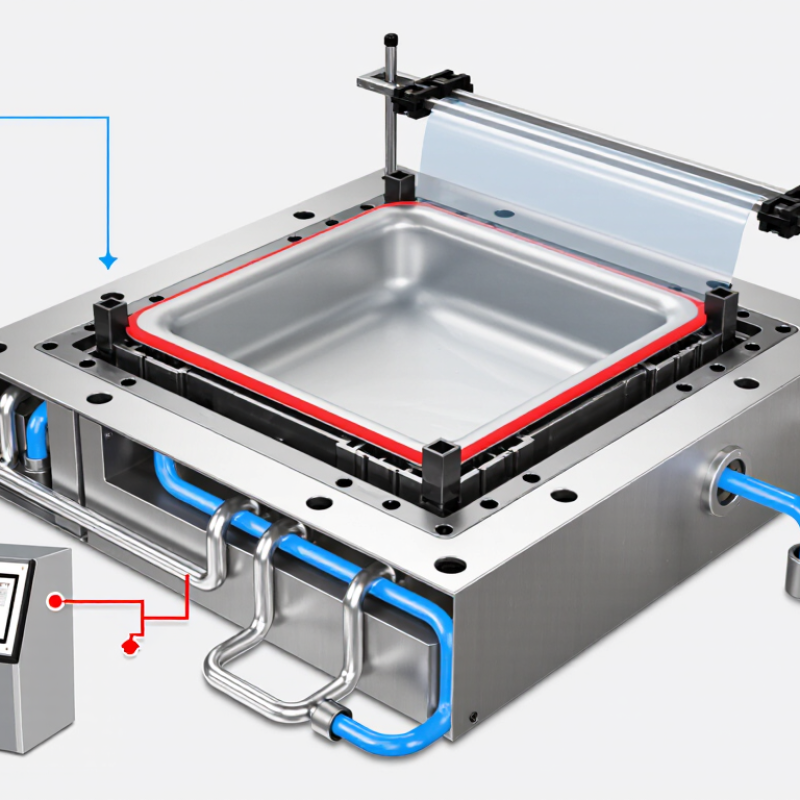
Table of Contents [Hide]
Definition and Purpose of a Thermoforming Mold Assembly
What Is Thermoforming Mold Assembly?
A thermoforming mold assembly is the complete tooling system that shapes a heated plastic sheet. It usually includes the mold body, mounting plates, vents, cooling channels, and locating features. Some assemblies also include plug assists, trim references, or pressure-forming components.
Its main purpose is to produce parts with consistent dimensions, clean surfaces, and reliable release. During forming, the softened sheet must contact the mold evenly. Small differences in vent placement can leave wrinkles, thin corners, or trapped air. Cooling channels then help the part solidify at a controlled rate.
A well-designed assembly also supports repeatable production. Technicians check alignment with reference pins and measure critical surfaces with gauges. They often review the first formed parts for wall thickness, edge definition, and distortion. Practical experience matters here. A drawing may appear correct, yet a trial run can reveal poor cooling or difficult demolding.
The assembly must match the material, sheet thickness, and expected production speed. Aluminum molds can offer efficient heat transfer, while other tooling materials may suit demanding wear conditions. The choice needs technical evaluation, not guesswork. Even a carefully built assembly is not perfect. Vent passages can become blocked, and cooling performance may change over time. Regular inspection helps identify these issues before they affect many parts. A thermoforming mold assembly is therefore both a forming tool and a controlled production system.
What Is Thermoforming Mold Assembly? - Definition and Purpose of a Thermoforming Mold Assembly
| Assembly Element | What It Is | ||
|---|---|---|---|
| Thermoforming Mold Assembly | A coordinated set of mold components used to shape a heated thermoplastic sheet or web into a defined three-dimensional form. | It provides the forming surface and supports the controlled creation of repeatable parts such as trays, containers, panels, and protective packaging. | The assembly must match the forming method, part geometry, material, and required production volume. |
| Mold or Tooling Surface | The male or female surface that determines the external or internal shape of the formed part. | It transfers the intended dimensions, contours, texture, and draft angles to the softened plastic sheet. | Smooth surfaces generally support easier release and more consistent appearance. |
| Base Plate | A rigid structural plate to which the mold and related components are attached. | It stabilizes the tooling, maintains alignment, and provides a connection between the mold and the forming machine. | Adequate stiffness helps reduce deflection during vacuum, pressure, or mechanical forming. |
| Vacuum Channels | Small passages or drilled openings that connect the mold surface to a vacuum system. | They remove air between the heated sheet and the mold so atmospheric pressure can draw the material against the forming surface. | Channel placement should support uniform material contact without leaving unwanted marks on the part. |
| Pressure-Air System | Air passages and fittings used to apply compressed air during pressure-assisted thermoforming. | It supplements vacuum forming by applying positive pressure, helping reproduce finer details and improve dimensional definition. | Pressure requirements depend on the material, thickness, mold design, and machine capability. |
| Cooling Channels | Internal passages through which water or another cooling medium circulates within the mold or mold plate. | They remove heat from the formed sheet, shorten cycle time, and help the part retain its shape during demolding. | Balanced cooling is important for reducing warpage, uneven shrinkage, and cycle-to-cycle variation. |
| Temperature-Control Components | Sensors, heaters, valves, and control connections used to monitor or regulate mold temperature. | They help maintain a stable thermal condition for consistent forming, surface quality, and dimensional accuracy. | The suitable temperature depends on the selected thermoplastic and the process window established during trials. |
| Parting Line | The planned boundary where mold sections, inserts, or trimming features meet. | It enables practical mold construction, part release, and integration with downstream trimming operations. | Its location should minimize visible marks and avoid locking the formed part onto the mold. |
| Draft Angle | A slight taper applied to vertical or near-vertical walls of the mold and finished part. | It allows the formed component to release from the mold with less friction and lower risk of deformation. | Deeper features and textured surfaces generally require more draft than shallow, smooth features. |
| Vent and Release Features | Small openings, ejector features, or air-release provisions incorporated into the mold design. | They help evacuate trapped air and support clean separation of the cooled part from the mold. | These features should be positioned to avoid cosmetic defects and unwanted impressions. |
| Alignment and Clamping Hardware | Pins, guides, fasteners, clamps, and locating features that keep assembly components in their intended positions. | They maintain repeatable registration between the mold, base, pressure box, cutting tools, and machine platen. | Secure alignment is essential when several forming or trimming stations operate in sequence. |
| Common Mold Materials | Tooling may be manufactured from aluminum, steel, epoxy-based materials, composite materials, or other suitable engineering materials. | Material selection affects thermal conductivity, durability, machinability, surface finish, weight, and tooling cost. | Aluminum is often selected for efficient heat transfer and machining, while harder materials may be used where extended wear resistance is required. |
| Forming Methods | Thermoforming mold assemblies may be used with vacuum forming, pressure forming, twin-sheet forming, or mechanical plug-assist processes. | The method determines how the heated plastic is moved against the mold and what supporting components are required. | Vacuum forming uses negative pressure; pressure forming adds compressed air; plug assist uses a mechanical pre-stretching element. |
| Typical Thermoplastics | Materials commonly processed by thermoforming include ABS, PET, PVC, PS, PP, PE, and polycarbonate grades. | The selected plastic determines heating behavior, forming temperature range, stiffness, shrinkage, appearance, and end-use performance. | Processing parameters must be established for the specific resin grade, sheet thickness, and part design. |
| Quality Objectives | The measurable performance targets applied to the finished formed part and the mold assembly. | Typical objectives include consistent wall thickness, accurate dimensions, reliable release, acceptable surface finish, and stable cycle time. | Mold design, sheet heating, vacuum or pressure distribution, cooling, and trimming must work together to achieve consistent results. |
A thermoforming mold assembly is not limited to the shaping surface alone; it includes the structural, air-management, thermal-control, alignment, and release features required to produce repeatable formed parts.